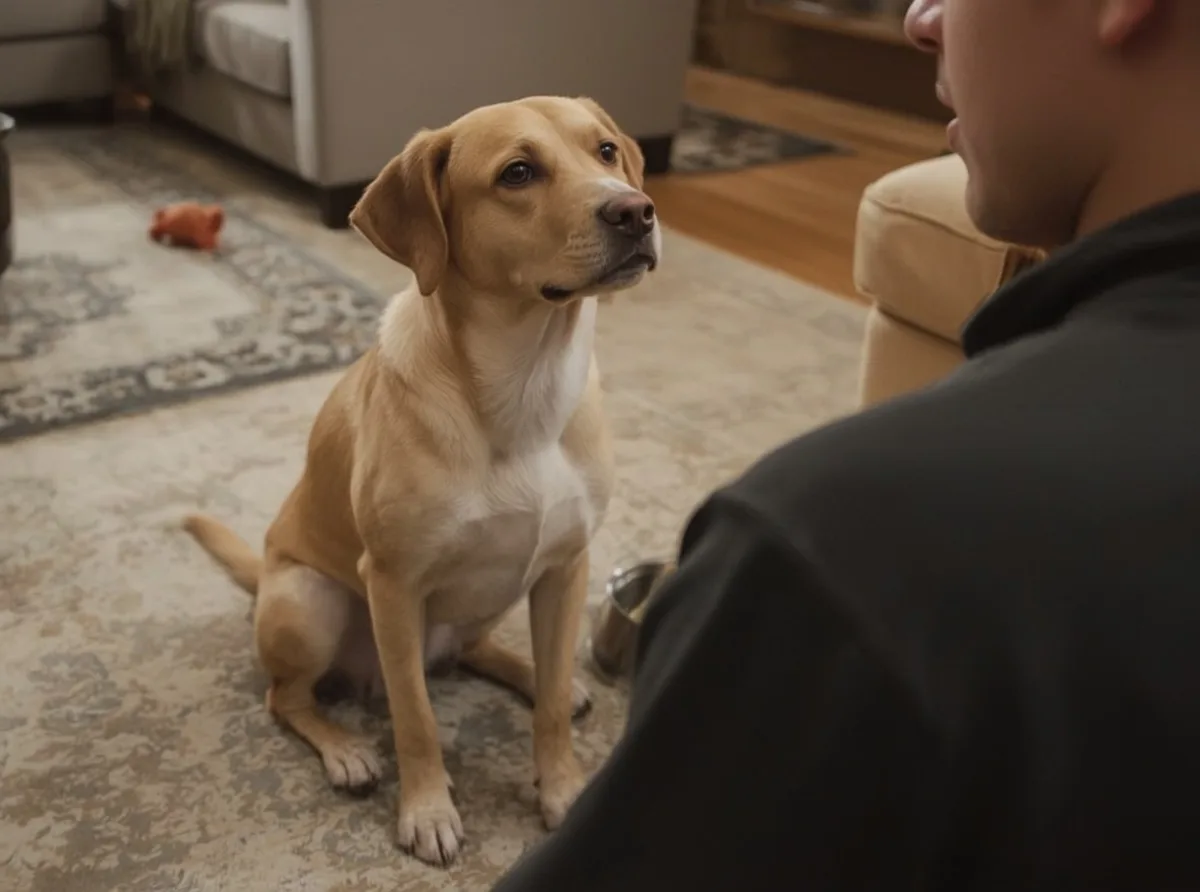
Few dog behaviors feel as instantly familiar as the head tilt. You speak, the dog leans in, and then that small sideways turn appears. It looks almost like a thoughtful reaction, as if the dog is trying to catch every word. That moment tends to make people smile because it feels so directed, so personal.
But the head tilt is more than a cute habit. Dogs do it for a mix of practical, social, and emotional reasons. Sometimes they are trying to hear better. Sometimes they are trying to read your face. And sometimes they are simply responding to something interesting, confusing, or emotionally meaningful in the interaction.
The behavior can show up in calm dogs, excitable dogs, nervous dogs, and deeply people-focused dogs. The meaning changes with context. A relaxed head tilt during a familiar conversation is not the same as a quick tilt paired with tension, stillness, or repeated alerting toward a sound.
What a dog head tilt often looks like in daily life
Most owners notice the head tilt during ordinary conversation. You say the dog’s name, mention a walk, ask a question in a bright voice, or speak with a particular tone, and the dog shifts its head to one side. Sometimes the movement is slow and deliberate. Other times it is quick and repeated, especially if the dog hears a sound that seems strange or if your voice catches its attention in a new way.
In many homes, the tilt appears in moments that feel almost like back-and-forth communication. A person talks, the dog tilts, the person keeps talking, and the dog seems to “stay with” the conversation. That response can make the dog look deeply engaged. In practice, it often is engaged, just not necessarily in the human sense of understanding words.
There are also dogs that tilt their heads when they hear specific phrases tied to routine. These dogs may react to words like “outside,” “treat,” “car,” or “walk.” The reaction may come from learned association rather than language comprehension. The dog notices a familiar pattern, anticipates something, and turns its head as part of a focused listening response.
The head tilt is usually a sign of attention, but attention can come from different places: curiosity, sound tracking, facial reading, anticipation, or mild uncertainty.
Why dogs commonly show this behavior
Dogs rely heavily on human cues. They watch faces, track tone, and listen for changes in the environment. A head tilt can help them process those cues more clearly. That makes the behavior especially common in dogs that are highly social or strongly bonded to their people.
One simple reason is sound. A dog’s ears are shaped differently from a human’s, and turning the head can help change the angle of incoming sound. If your voice comes from one side or if a noise is partially blocked, tilting may help the dog localize it. This is especially noticeable when the sound is soft, unusual, or difficult to place.
Another reason is visual. Dogs do not see the same way people do, and the shape of their muzzle can block part of their view. Tilting the head may improve their ability to see your mouth, your eyes, or the movement of your face. This matters during conversation, because dogs often combine sound with visual reading.
Dogs also tilt their heads when they are trying to connect a sound with a known meaning. If a word, tone, or sentence pattern feels important, the dog may pause and orient more carefully. The tilt can appear when the dog is thinking through what comes next, especially if the conversation includes a predictable routine.
How hearing and vision influence the head tilt
Because dogs process the world through both hearing and sight, the head tilt often has a practical side. A dog with upright ears may not need to move as much as one with floppy ears, but both can benefit from repositioning the head. The angle can help sharpen the sound or adjust what the dog sees in front of it.
For some dogs, a wide muzzle may block the lower part of the face when they are looking straight ahead. That means a tilt can help them read the shape of the mouth or the movement of the jaw. This is one reason the behavior may appear more often while a person is speaking than when a person is simply standing quietly nearby.
Dogs with strong hearing may still tilt their heads when they hear a voice that is emotionally charged, unusual in pitch, or paired with an important event. The tilt is not proof that the dog understands every word. It is more often a sign that the dog is sorting through information and trying to make sense of it.
Common sensory triggers
- A soft or distant sound
- A new or unusual word
- A tone that signals excitement or concern
- Speech that seems connected to a routine event
- A sound coming from an unclear direction
How dogs use head tilts to read people
Dogs are very good at observing people. They track posture, facial changes, and movement patterns, often with more consistency than owners realize. The head tilt can be part of that social reading. By adjusting the angle of the head, the dog may improve its view of your face and keep your expression in sight.
This matters because dogs respond not only to words but also to the emotional tone behind them. A cheerful voice, a stern voice, and a worried voice can all feel different to a dog even if the same words are used. The tilt can show up when the dog is paying close attention to that emotional layer.
Some dogs seem to tilt when they are trying to predict what you will do next. They notice your hands, your movement toward the door, the leash in your grip, or your stance near the kitchen. In those moments, the tilt is part listening, part watching. It is a small adjustment that helps the dog gather more detail.
When a dog tilts its head while watching your face, it may be trying to improve both hearing and visual access at the same time.
The emotional side of the behavior
The head tilt is often linked to curiosity. That does not mean simple curiosity alone explains every case, but it is one of the clearest emotional patterns behind the gesture. A dog that feels interested in what you are doing is more likely to orient toward you and adjust its head as if trying to decode the moment.
Anticipation can also play a role. Dogs learn quickly when certain words or routines lead to something desirable. If your tone changes before a walk, meal, ride, or game, the dog may tilt its head because it senses a meaningful cue. The tilt then becomes part of a learned sequence of expectation.
In some dogs, the behavior appears during mild uncertainty. The dog may not feel scared, but it may feel unsure enough to pause and examine the situation more carefully. A small tilt can accompany a soft body, a closed mouth, and steady eye contact. That combination often suggests a dog that is processing rather than reacting.
Excitement can also show up this way. Some dogs tilt when they are emotionally activated and trying to stay focused. The movement may be brief, followed by a tail wag, a step forward, or a quick shift into action. In that case, the tilt is less about careful analysis and more about heightened engagement.
What the tilt can signal about internal state
By itself, a head tilt does not tell the whole story. The surrounding body language matters much more. A dog that tilts with loose muscles, soft eyes, and a relaxed mouth is usually in a very different state from a dog that tilts with a frozen body, tight lips, and fixed staring.
In calm settings, the tilt often reflects comfortable attention. The dog is interested, engaged, and not under stress. That is why the behavior can be so common in friendly conversations, quiet living rooms, and predictable parts of the day.
In busier settings, the tilt may show concentration. The dog could be tracking several things at once: your voice, a sound from outside, another pet moving nearby, or a shift in the room. The gesture becomes part of information gathering.
There are also situations where the tilt may accompany stress or confusion, although it is not a direct sign of either on its own. If the posture looks stiff, the breathing changes, or the dog repeatedly tilts without settling, the dog may be trying to interpret something that feels unfamiliar. Context decides the meaning.
Body language cues that help interpret a tilt
- Loose body and soft expression: relaxed curiosity
- Forward lean and focused eyes: active attention
- Repeated tilts with hesitation: uncertainty or careful processing
- Stiff posture and fixed stare: possible alertness or tension
- Tail movement and quick recovery: excitement or anticipation
Why some dogs do it more often than others
Not every dog head tilts with the same frequency. Breed traits, ear shape, facial structure, hearing sensitivity, and personality all affect how often the behavior appears. Dogs that are especially people-oriented may do it more because they are constantly monitoring their humans.
Dogs with floppy ears often get noticed because their ears can change the way their head position looks. A tilt may be more visible or more dramatic. Dogs with long muzzles, short muzzles, upright ears, or heavy facial fur may also tilt differently simply because their faces and hearing cues differ.
Learning matters too. If a dog has been rewarded with attention, laughter, or a warm response every time it tilts, it may repeat the behavior more often. Dogs are good at noticing what gets a reaction. Over time, the head tilt can become part of a social routine between dog and owner.
That does not mean the dog is “performing” in a fake sense. It means the behavior is reinforced by interaction. The dog notices that the movement often leads to engagement, and engagement is something many dogs value highly.
How environment and daily routine affect the behavior
A quiet home may make the head tilt easier to notice because small sounds stand out. In a busy household, the behavior may appear during moments when the dog is trying to filter out background noise and focus on one person. The same gesture can mean slightly different things depending on how much stimulation is happening around the dog.
Routine also shapes the response. Dogs live by patterns. They notice the sound of shoes, the movement toward the leash hook, the opening of a cabinet, or the exact tone used before feeding time. A head tilt can appear when the dog recognizes that a routine is shifting and wants to confirm what is coming next.
Daily stimulation plays a role as well. A dog that is mentally under-stimulated may become overly alert to ordinary conversation because it is seeking engagement. A dog that is highly stimulated may tilt its head as part of a brief pause in a busy day. In both cases, the dog is processing information, but the broader emotional setting differs.
When the behavior becomes more noticeable
Head tilting often stands out in a few predictable moments. It may happen when you use an unusual tone, when the dog hears a new sound, or when the conversation includes a word connected to an event the dog cares about. It can also show up when the dog is tired but still interested, or when the house is unusually quiet and every small cue feels amplified.
Some dogs do it most during one-on-one interaction. They may barely tilt when a room is full of noise, but they become highly attentive when one person speaks directly to them. Other dogs respond most when hearing something unfamiliar. A strange sound outside, a whistling appliance, or a new voice can all prompt the same adjustment.
Pay attention to patterns. If the tilt appears mainly during playful conversations, it probably reflects social interest and attention. If it appears mostly when the dog is uncertain about a sound, it may be more about localization and careful assessment. Patterns reveal more than the gesture alone.
A single head tilt is not a diagnosis of mood. Repetition, posture, ear position, mouth tension, and timing give the clearest picture.
Common misunderstandings about the head tilt
One common mistake is assuming the dog is understanding every word being said. Dogs can learn many word associations, but the head tilt is not proof of human-level language comprehension. More often, it shows that the dog is linking sound, tone, and context in a meaningful way.
Another misunderstanding is thinking the tilt always means affection. Many affectionate dogs tilt their heads, but so do dogs that are merely curious, attentive, or unsure. The behavior is socially rich, but it is not limited to one emotional message.
People also sometimes assume a tilt means the dog is confused in a negative sense. That is not always true. Confusion, when present, is often mild and temporary. The dog may simply be trying to process a sound or face more clearly before deciding what to do next.
How to read the behavior in real life
Reading the head tilt well means looking at the whole moment. Is the dog relaxed and engaged, or stiff and watchful? Is the tilt followed by movement toward you, a tail wag, or a soft blink? Or does the dog stay frozen, as if listening for something outside the room?
If the tilt happens during a calm conversation and the dog’s body looks loose, it usually reflects interest and social connection. If it appears whenever a specific sound happens, the dog may be tracking the source of that sound. If the dog repeatedly tilts in a new environment, it may be orienting to unfamiliar input.
It can help to notice when the behavior does not happen. Some dogs rarely tilt their heads at all, even when they are attentive. That does not mean they are uninterested. They may simply use other ways to process sound and facial cues.
Questions worth noticing
- Did the dog tilt after a word, a noise, or your facial expression?
- Was the body loose or tense?
- Did the dog move closer after tilting?
- Was the setting quiet or full of distractions?
- Did the behavior happen once or repeatedly in the same context?
What the behavior can reveal about dog-human communication
The head tilt fits neatly into the way dogs communicate with people. Dogs are not only reacting to sounds; they are reading the entire social scene. A conversation with a dog is often less about vocabulary and more about rhythm, tone, timing, and shared routines.
That is part of why the gesture feels so meaningful. When a dog tilts its head while you talk, it looks like participation. And in a practical sense, it often is participation. The dog is choosing to focus on you, filtering what matters, and adjusting its position to gather more information.
Over time, many dogs develop a pattern of responding to certain voices, phrases, or moods. The tilt becomes one small piece of that exchange. It reflects the dog’s effort to stay connected to the human world, which is full of cues that are interesting, useful, and sometimes difficult to sort out.
The behavior remains charming because it is both functional and expressive. A dog does not need to tilt its head to survive the day, but the movement helps with hearing, seeing, and social reading. That combination makes it one of the clearest examples of how dogs adapt to life alongside people.
When a dog leans in, turns the head, and holds that curious angle for a moment, the gesture often says more than simple attention. It shows a mind that is listening, checking, comparing, and deciding what this human conversation might mean right now.