A dog that reacts strongly when visitors arrive is not being dramatic for no reason. The reaction usually has roots in instinct, past experiences, the home environment, or the way the dog reads strangers entering its space. In some dogs, the behavior looks like excitement. In others, it comes across as alarm, frustration, or a mix of several emotions at once.
What makes visitor reactions so noticeable is that they often appear fast. The doorbell rings, footsteps approach, and the dog shifts from quiet to intense in seconds. That change can confuse owners, especially when the same dog seems calm during the rest of the day.
Those moments are often a snapshot of something deeper. A dog may be protecting territory, seeking social contact, reacting to unfamiliar movement, or responding to a history of unstable encounters with guests. The stronger the reaction, the more useful it is to look at the full pattern instead of the single moment at the door.
What Strong Reactions to Visitors Look Like in Daily Life
Not every dog shows visitor sensitivity in the same way. Some bark continuously the moment a door closes. Others rush toward the entryway, circle the room, or jump on anyone who comes inside. A few dogs freeze, stare, and hold a tense body before suddenly exploding into barking or lunging.
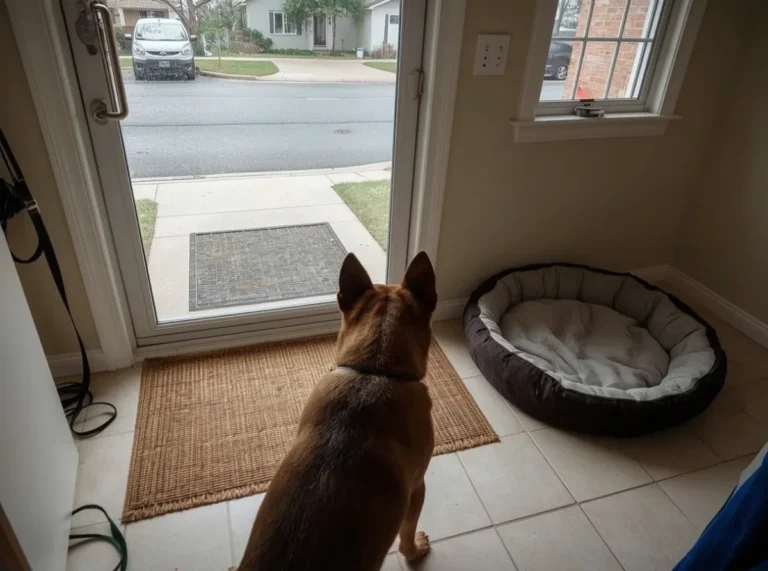
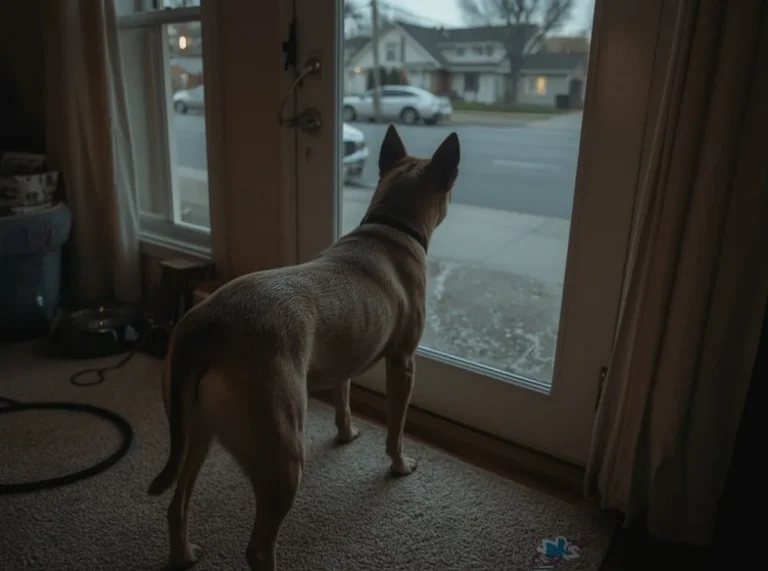
There is also a quieter version of the same issue. A dog may stay close to the owner, refuse treats, pace along the hallway, or keep returning to the window to watch arrivals. These signs can be easy to overlook because they do not always look “reactive” in the obvious sense.
In everyday life, the pattern often includes a predictable sequence. Sounds from outside trigger alertness, the door opens, the dog reaches a peak of arousal, and then the behavior continues until the visitor settles in. For some dogs, the hardest part is not the stranger itself but the transition from anticipation to direct contact.
Strong visitor reactions are often less about “bad manners” and more about a dog feeling overstimulated, unsure, or highly invested in what happens at the front door.
Why Some Dogs React So Strongly
One of the most common reasons is territorial instinct. A dog’s home is not just a place to sleep; it is also part of the space they monitor. When someone enters, the dog may interpret that as a meaningful event that requires a response. Barking, posturing, and moving quickly toward the door can all come from this built-in tendency.
Attachment plays a role too. Many dogs form a close bond with their household and see visitors as interruptions to that familiar structure. If the dog is especially attached to one person, guests may create a sense of competition or uncertainty. The dog may not want the person to leave, or may not know how to behave in the presence of someone new.
Sensitivity matters as well. Some dogs notice every change in sound, smell, and movement. A new voice in the hallway, a coat rubbing against the chair, or a different walking rhythm can be enough to trigger a strong response. These dogs are not necessarily fearful, but they often process the environment more intensely than others.
Past learning can shape the reaction just as much as instinct. A dog that has previously been startled by guests, handled roughly, or overwhelmed by too many people at once may begin to anticipate trouble. Once that pattern settles in, the dog may react before the visitor even steps inside.
The Emotional States Behind the Behavior
It is tempting to label the behavior as aggression or excitement and stop there, but the emotional picture is usually more layered. A dog barking at visitors may feel worried, over-aroused, protective, uncertain, or eager for interaction. Sometimes all of those are present together.
Fear often hides behind intensity. A dog that seems loud and forceful may actually be trying to increase distance. The barking says, in effect, “This is too much, please stay back.” The body may support that message with tension, a rigid tail, closed mouth, or quick retreat after the initial burst.
Excitement can look equally strong, but the energy is different. The dog may wiggle, spin, vocalize, and attempt to greet every person at once. Even so, a highly excited dog can still be overwhelmed. The line between happy enthusiasm and emotional overload is not always easy to see in the moment.
Frustration appears when the dog wants access but cannot get it. This often happens behind gates, crates, or doors. The dog sees people coming and going, cannot control the situation, and reacts with barking or persistent movement. The visitor is not the whole problem; blocked access is part of the picture too.
When a dog reacts strongly to visitors, the behavior often reflects arousal first and intention second. The dog may be trying to manage feeling, not trying to make a point.
Subtle Signals That Often Show Up Before the Outburst
The earliest signs are easy to miss if attention goes straight to the barking. A dog may pause what it is doing, turn its head toward the sound, and hold still for a second or two. That stillness can mean the dog is collecting information before deciding how to respond.
Body posture offers important clues. A forward-leaning stance can suggest interest or challenge, while a lowered body with tucked movement may point toward unease. Some dogs alternate between the two, which is one reason visitor behavior can seem inconsistent from one minute to the next.
Eyes, ears, and mouth also matter. Wide eyes, fixed staring, tightly pulled lips, rapid panting, and ears that shift sharply forward or back can all appear before the dog vocalizes. The dog may look like it is “watching” the visitor closely, but the real message is often that it is working hard to interpret the situation.
Movement can be revealing too. A dog that keeps looping around furniture, pacing the entryway, or repeatedly running to the door and back may be preparing for interaction long before it happens. Some dogs can maintain that state for a long time, which makes the eventual visitor contact even more intense.
How the Home Environment Shapes Visitor Reactions
A quiet, predictable home can make visitor arrivals stand out sharply. If the dog spends most of the day with limited stimulation, the sound of a visitor may become one of the biggest events in the room. The reaction is then partly about contrast. The dog is not simply responding to a person; it is responding to a sudden break in routine.
Busy households can create the opposite problem. Constant movement, multiple voices, and frequent comings and goings may keep the dog on alert. In that setting, the dog may react strongly because it has learned to stay watchful. Visitors become another layer on top of a house that already feels active.
Space matters as well. Some dogs feel more secure when they can observe from a distance, while others become more reactive when they are trapped in a narrow hallway or crowded entryway. The front door, in particular, can become a high-pressure point because it is where all of the energy seems to collect.
Routine can either soften or intensify the response. A dog that knows what usually happens when the bell rings may settle more quickly. But if visitors appear unpredictably, or if they arrive in loud clusters, the dog may never learn a comfortable pattern. The uncertainty itself can become part of the trigger.
Environmental Factors That Often Increase the Reaction
- Frequent interruptions at the door
- Limited daily mental and physical activity
- Visitors arriving in large groups
- Guests who move quickly or speak loudly
- Confined entry spaces with little room to retreat
- Inconsistent household routines around greetings
Why Some Dogs Are More Sensitive Than Others
Temperament is a major piece of the puzzle. Some dogs are naturally steady and slow to react, while others are quick to notice changes and respond strongly. Neither type is “better,” but the sensitive dog is usually the one whose visitor behavior becomes obvious first.
Breed tendencies can influence the style of reaction, though they do not determine it completely. Dogs bred for guarding, herding, or close human partnership may be more alert to changes around the home. That does not automatically mean they will be reactive, but it can make the front-door moment more meaningful to them.
Age matters too. Young dogs may react strongly because everything is still new. Adult dogs may have learned habits around greeting and guarding. Older dogs may become more vigilant again if hearing or vision changes make incoming visitors harder to interpret.
Health deserves attention. Pain, hearing changes, vision loss, or cognitive decline can make unfamiliar people feel even more disruptive. A dog that once greeted visitors calmly but now startsle-reacts or barks earlier than before may not simply be “more stubborn.” The body may be changing the way the dog experiences the world.
How Owners Often Misread the Reaction
One common mistake is assuming all strong reactions mean the dog is unfriendly. A dog that barks loudly at a visitor may still want contact, but not on the same terms or at the same speed. The reaction is sometimes a request for space, not a rejection of people altogether.
Another misunderstanding is treating all visitor excitement as harmless because it looks happy. Jumping, spinning, and frantic greeting can be socially intense. The dog may be thrilled, but the level of arousal can still make it difficult to settle, listen, or make good choices once the visitor is inside.
Owners also sometimes assume the dog “knows better” and is being stubborn. In reality, many dogs are caught in a habit loop. The arrival of visitors activates a rehearsed emotional response, and the behavior comes out automatically. Expecting quick self-control in that moment often ignores how strongly the pattern has been practiced.
What looks like disobedience is often a dog repeating a familiar emotional script. The behavior is usually easier to understand when seen as a pattern, not a choice made from calm reflection.
Different Forms of the Same Reaction
Some dogs react in a way that appears social but still intense. They bark, then wag hard, then rush in for contact. These dogs may be eager, but they are not necessarily settled. The energy is high enough that the greeting can become overwhelming for both the visitor and the dog.
Other dogs show a defensive pattern. Their body becomes stiff, they keep distance, and they may bark from a fixed spot. This behavior often signals that the dog needs more time, more space, or a better way to observe before approaching. The reaction is about control and safety, not just noise.
There are also mixed signals. A dog may bark and retreat, then come back closer, then bark again. This push-pull pattern often means the dog is torn between curiosity and discomfort. Those dogs can be especially tricky for owners to read because the behavior changes moment by moment.
In some homes, the reaction becomes almost ritualized. The dog always barks at the same stage: when the doorbell rings, when the visitor steps onto the mat, or when the owner begins speaking in a certain tone. Predictable triggers create predictable habits, and those habits are often stronger than people realize.
Common Visitor Reactions and What They May Suggest
| Behavior | Possible Meaning |
|---|---|
| Continuous barking at the door | Alertness, territorial response, or frustration |
| Jumping and spinning | High excitement, poor impulse control, or overstimulation |
| Stiff body and fixed stare | Uncertainty, caution, or defensive posture |
| Pacing and checking the door repeatedly | Anticipation, tension, or difficulty settling |
| Hiding behind furniture or the owner | Need for distance, shyness, or worry |
Why the Front Door Can Become Such a Big Deal
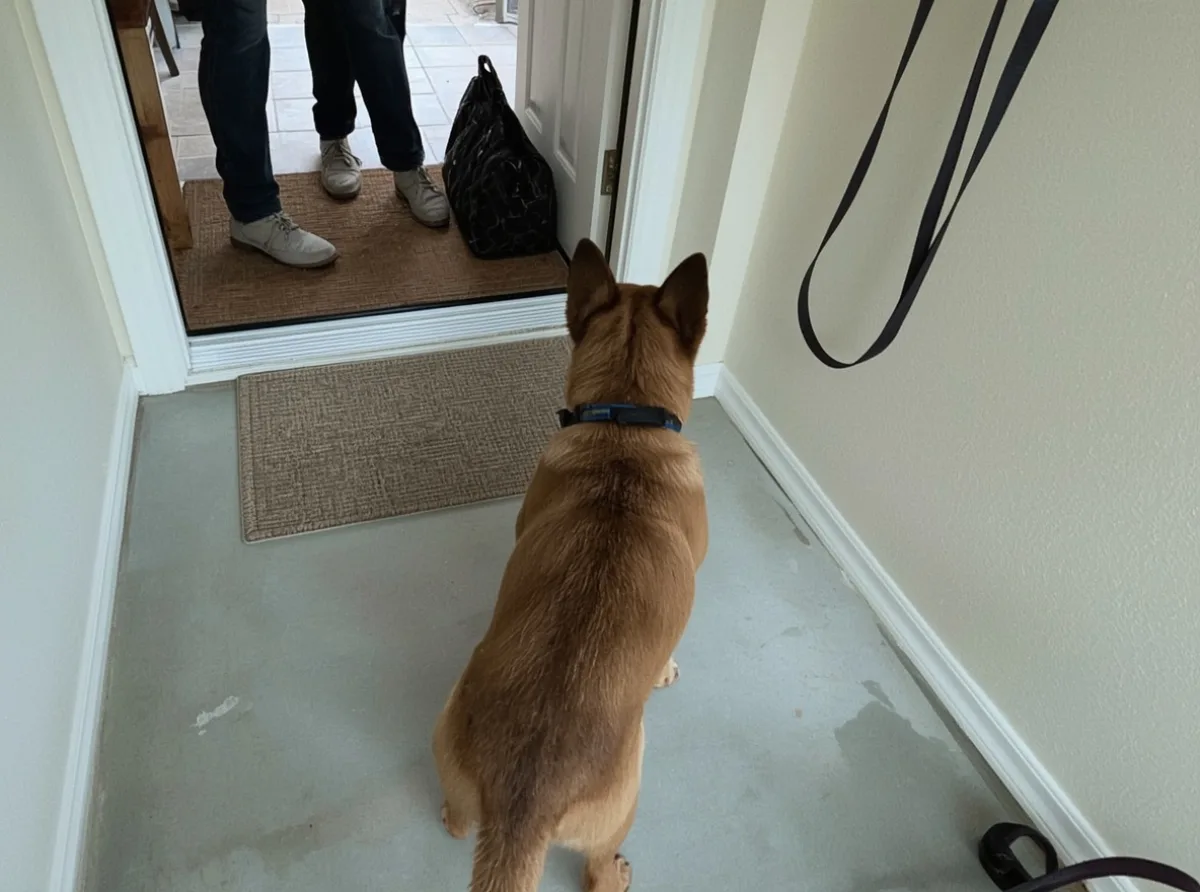
The front door has a special status in many dogs’ minds. It is the boundary between the familiar and the unknown. Sounds from outside often begin the emotional response long before the visitor is visible, so the dog has already started processing the situation by the time anyone steps in.
That buildup matters. A dog that hears footsteps on the porch, the door handle turn, and voices nearby may feel a rising wave of arousal. When the actual person appears, the reaction is not from a blank slate. It is the peak of a sequence that has been building for several seconds or even minutes.
Once the pattern becomes familiar, the dog may respond to tiny details. A knock versus a bell, a male voice versus a female voice, a familiar visitor versus a delivery person, or a person carrying an object can all provoke different levels of intensity. Dogs are often more observant than owners expect.
That is why the same dog may greet one person calmly and another with intense barking. The issue is not always “visitors” in general. It may be a particular set of cues that make the situation feel safer, stranger, more exciting, or more threatening.
Long-Term Patterns and What They Often Reveal
When visitor reactions stay strong over time, the consistency itself becomes informative. A dog that reacts in nearly the same way across different settings may be showing a stable temperament trait. A dog that reacts only when tired, bored, or in a certain room may be responding more to context than to the visitors themselves.
Patterns over months can also reveal whether the response is intensifying, softening, or simply remaining unchanged. A sudden increase in reactivity may point to stress, health changes, or a shift in household routine. A gradual decrease may reflect greater familiarity, improved predictability, or a calmer environment.
It helps to notice what precedes the reaction. Does it happen after a long quiet day, when the dog has energy built up? Does it flare up when the house is crowded? Does it appear mostly at night, when the dog seems more alert? Those details often explain more than the reaction itself.
Dogs do not react to visitors in a vacuum. They respond to the whole situation: the sounds, the smells, the timing, the movement, the owner’s tone, and the history attached to the doorway. That is why certain dogs react strongly even when the visitor appears harmless. The dog is reading a familiar pattern, not a single person.
Natural Instinct, Social Bonds, and Modern Homes
The modern home creates a strange mix for dogs. Visitors are usually welcomed by people, yet they appear in the same space a dog considers personal territory. That mismatch can be confusing. The dog is expected to relax around an event that feels meaningful, unfamiliar, and sometimes invasive.
At the same time, dogs are social animals. Many want contact, information, and reassurance from both humans and the environment. A visitor can be interesting, exciting, and alarming all at once. The strong reaction is often the place where those impulses collide.
When owners understand that collision, the behavior becomes easier to interpret. A strong response is not always about dominance, and it is not always about fear. More often, it is the result of a dog trying to handle too much input too quickly. The reaction is the visible part of an internal process that begins before anyone has even stepped through the door.
That is why calm, consistent observation matters. The way a dog reacts to visitors can tell a detailed story about sensitivity, confidence, routine, and emotional load. The story is usually written in small cues first, then in the louder behavior that follows.