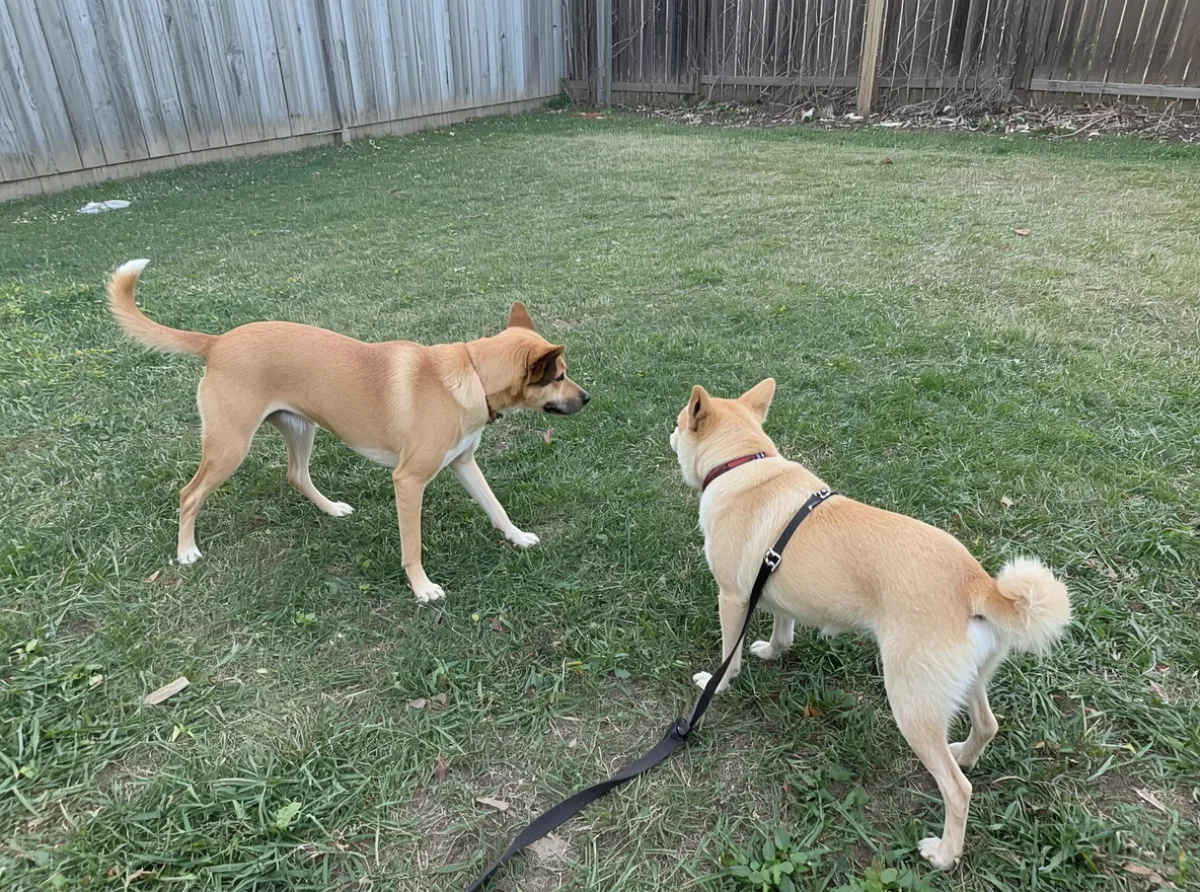
Some dogs walk up to a greeting with their heads high, tails moving, and bodies loose. Others come in lower, almost crouching as they approach. That lowered posture can catch people off guard, especially when the rest of the dog seems interested and friendly.
This kind of greeting is common, and it does not always mean the same thing from one dog to the next. A lowered body can show politeness, excitement, uncertainty, playfulness, or a mix of feelings all at once. The context matters more than the single movement.
Dog greetings are rarely one-note. A dog may lower its body because it wants to approach carefully, because the other dog feels overwhelming, or because it is trying to soften the interaction. The same posture can show up in very different situations, which is why body language has to be read as a whole.
What a lowered greeting looks like in real life
In everyday settings, the lowered body usually appears right before contact. The dog may approach with bent elbows, a slightly crouched back, or a rear end that sinks closer to the ground. Sometimes the movement is brief. Other times the dog stays low for the entire greeting.
Tail position often adds more meaning. A loose wag may suggest friendliness or social caution, while a stiff or tucked tail can point to tension. Ears, eyes, and walking speed also matter. A dog that lowers its body but still moves forward easily is communicating something different from a dog that freezes in place.
Owners often notice this behavior at gates, in parks, on sidewalks, or when a visitor enters the home. It may happen most often with unfamiliar dogs, but some dogs do it with people too. The pattern usually becomes clearer over time if you watch where, when, and with whom it appears.
Why some dogs naturally greet lower to the ground
Many dogs use lowered posture as part of ordinary social communication. Dogs do not greet each other face-to-face in a direct human way. They rely on subtle movements to show that they are not a threat and that they want the other dog to feel comfortable.
A lowered body can act like a soft opening. It may tell the other dog, “I’m coming in gently.” This is especially common in dogs that are thoughtful around new social situations. They may be friendly, but they prefer to reduce pressure before moving closer.
Lowering the body during greeting is often less about fear and more about managing social distance. The dog may want connection without pushing too fast.
Some dogs seem to have a naturally careful style. They approach in curves, pause often, or lower their front end before getting close. Others are simply more aware of other dogs’ reactions. Sensitive dogs may use this posture to avoid triggering conflict or excitement.
Emotional reasons behind the posture
Emotion is a major part of this behavior. A dog that lowers its body while greeting may be feeling a little unsure, especially if the other dog is larger, more energetic, or already focused in a way that feels intense. The dog may still want to say hello. It just wants to do so from a safer emotional distance.
Shyness can play a role. So can caution. Some dogs are naturally slower to warm up and prefer to test the situation before moving in fully. The lowered body becomes a kind of compromise. It allows the dog to participate in the greeting while keeping its comfort level intact.
Excitement can also cause a lowered stance. A dog that is eager to meet another dog may crouch, wiggle, or bounce low to the ground. In that case, the posture is less about worry and more about arousal. The body is compressed, but the overall energy feels light and forward-moving.
Common emotional drivers
- Caution around unfamiliar dogs or people
- Polite, low-pressure social signaling
- Excitement that comes out as crouching or bouncing
- Uncertainty in busy or noisy places
- Appeasement when the dog wants to avoid tension
The same dog may show different versions of the behavior depending on mood and setting. A confident dog can still lower its body when meeting a very large or intense dog. A nervous dog may do it almost every time. The body language shifts with the emotional load of the moment.
How play changes the meaning
Playful greetings often look low to the ground. Puppies do this constantly, but adult dogs may use it too. A low posture can become an invitation: “I want to play, and I am not challenging you.” That message is especially common when the dog’s front end dips and its hindquarters stay loose or ready to move.
The difference between play and tension shows up in the details. A playful dog tends to have a loose face, quick recovery after each movement, and a body that springs back into motion. A tense dog may stay compressed, hold its breath, or keep its weight unnaturally still.
If the greeting includes repeated bows, quick side steps, or short bursts of movement, the dog may be trying to start or sustain play. If the body remains low but rigid, the message is less open. The posture may still be social, but it carries caution.
A low greeting is not automatically submissive or fearful. In many dogs, it is simply the position that helps them approach another dog in the safest, clearest way.
The role of environment, routine, and stimulation
Where the greeting happens can change everything. A dog in a quiet backyard may lower its body out of gentle curiosity. The same dog on a crowded sidewalk may crouch lower because it feels overstimulated. Noise, movement, and tight spaces all affect how comfortable a dog feels when meeting others.
Routine matters too. Dogs that regularly meet calm, familiar dogs often develop smooth, low-pressure greetings. Dogs that are rarely socialized may use a lowered body because the whole interaction feels bigger and harder to predict. Even dogs with good social skills can become more cautious after a bad encounter.
Stimulation from the day can also influence greeting style. A dog that has not had enough activity may greet in a more compressed, excitable way. A tired dog may greet low and slow. A dog that has already been overstimulated by a busy outing may look lower simply because it is trying to regulate itself.
Situations where lowered greetings show up more often
- Approaching unfamiliar dogs in public spaces
- Meeting larger dogs that seem intense or direct
- Greeting after a long car ride or overstimulating outing
- Reuniting after separation, when excitement is high
- Entering a new home, yard, or shared play area
Owners sometimes notice that the behavior appears only in certain places. That is a useful clue. A dog that greets normally at home but lowers its body at the park is probably reacting to the environment, not just the social interaction itself.
What owners often misread
People sometimes assume a lowered body means the dog is scared. That can be true, but it is not the only explanation. Others think the dog is being stubborn, distant, or rude. Those ideas miss the point entirely. The dog is usually trying to communicate in a way that works for its current level of comfort.
Another common mistake is to focus only on the front end. A dog may lower its chest but keep its tail loose and wagging. That is very different from a dog that lowers its whole body and stays frozen. One suggests flexible social interest. The other may suggest caution or discomfort.
The speed of the approach matters as well. A dog that creeps in slowly with a low body is telling a different story than a dog that darts up low, then springs away again. The first may be unsure. The second may be playful, reactive, or both.
Signals that help explain the greeting
Body language works in layers. If you want to understand why a dog lowers its body during greeting, look at what happens around the posture. One signal rarely gives the full answer.
- Eyes: Soft eyes usually suggest comfort, while hard staring can suggest tension.
- Ears: Relaxed ears often go with a friendlier greeting; pinned or very forward ears may need more context.
- Mouth: An open mouth and loose jaw can suggest ease, while a tight mouth can suggest stress.
- Tail: Loose and moving is different from stiff, high, or tucked.
- Movement: Curved, bouncy, or stop-start movement often shows more social flexibility than rigid motion.
A dog that lowers its body and also turns its head away, sniffs the ground, or approaches in an arc may be trying to reduce social pressure. That can be a healthy, normal strategy. A dog that lowers its body and then cannot move forward may be overwhelmed. The difference is small, but important.
How puppies use this posture
Puppies lower their bodies often because they are still learning how to greet. Their social style is unfinished. They may crouch, bounce, roll, or approach in awkward little bursts. Much of that behavior is practice.
At this stage, lowering the body is often part play and part learning. Puppies test distance. They explore reactions. They pick up on what feels safe, what gets attention, and what causes another dog to step back. A lowered body can help them stay in the interaction without coming across as too bold.
As puppies mature, the posture may become more polished or more specific. Some dogs keep the habit of greeting low, but with better control. Others outgrow the crouched style and begin to greet in a more upright way. Both paths can be normal.
How adult dogs differ from puppies
Adult dogs usually have clearer reasons for lowering their bodies. They may do it because they know the social situation and want to keep it calm. They may do it because they are uncertain and prefer a careful approach. They may also do it because they have learned that this posture helps avoid conflict with certain dogs.
In mature dogs, repetition is often meaningful. If a dog lowers its body every time it meets boisterous dogs but not quiet ones, that tells you something about preference and social comfort. If it lowers its body only in new places, the environment may be the main factor. Adults are often more consistent than puppies, which makes their body language easier to track.
Some dogs develop a strong habit of low greetings after early social experiences. Others become more restrained with age. A dog that once rushed into every greeting may learn, through experience, that a slower, lower approach works better.
Calm, reactive, and defensive versions of the same posture
Lowered body language does not always mean the same thing. A calm dog may lower its body as a polite start. A reactive dog may do it because it is aroused and trying to manage intensity. A defensive dog may lower its body while preparing to avoid, freeze, or protect space.
The difference is often seen in what happens next. A calm dog usually moves in and out easily. A reactive dog may lunge, bounce, or shift suddenly. A defensive dog may hold very still, lick its lips, or keep the interaction short. The posture may look similar for a moment, but the sequence reveals the emotional state.
| Greeting style | Body posture | What usually follows |
|---|---|---|
| Calm | Loose, low, flexible | Easy sniffing, relaxed movement |
| Playful | Low with bounce | Chasing, bowing, quick returns |
| Cautious | Lowered, slower, curved approach | Pause, sniffing, gradual contact |
| Defensive | Low but tight or frozen | Retreat, avoidance, or sharp reaction |
That table is useful only if you pair it with real observation. No single movement proves the feeling behind it. But the pattern over several greetings usually becomes clear.
Mixed signals and unclear greetings
Dogs do not always feel one thing at a time. A dog can be happy to greet and still uncertain about how the other dog will respond. That mix often creates posture that looks confusing from the outside. The dog lowers its body, then leans forward, then pauses, then wags again.
These mixed signals are common in dogs with a thoughtful social style. They want the interaction, but they do not want to rush it. The lowered body gives them room to adjust. It can be a bridge between interest and caution.
Owners sometimes expect dog greetings to look neat and obvious. Real dogs rarely work that way. Their body language shifts in tiny ways as they gather information. A lowered stance may be one part of that ongoing adjustment.
When a greeting looks mixed, the best clue is often what the dog does after the first second or two. Flexible movement usually means the dog is coping well. Stuck, rigid, or escalating movement calls for more caution.
How long-term patterns matter
Some dogs lower their bodies only occasionally. Others make it a regular part of every greeting. Long-term consistency can tell you a lot about the dog’s social preferences. A predictable low greeting style may simply be part of the dog’s personality.
If the behavior changes suddenly, that deserves attention. A dog that has always greeted easily but begins lowering its body more often may be responding to pain, discomfort, stress, or a recent negative experience. Changes in posture are worth noticing because dogs often adjust body language before people notice anything else.
Over time, many dogs settle into a stable greeting pattern. They learn which dogs feel easy, which situations feel busy, and how close they want to get before making contact. Lowering the body becomes one tool in that social routine. It can stay consistent for years, or it can shift as the dog ages and gains experience.
What this behavior usually means in daily life
In practical terms, a lowered greeting is often a sign that the dog is not rushing the interaction. That can be good news. It may mean the dog has enough social awareness to approach with care. It may also mean the dog is trying to stay comfortable in a situation that feels a little complicated.
When you see it often, look for the pattern rather than the posture alone. Is the dog loose and curious? Is it tense but interested? Does it greet lower only with certain dogs, or in certain places, or after certain kinds of days? Those details explain more than the crouch itself.
Dogs use their bodies to make social space. A lowered greeting is one of the clearest ways they do that. Sometimes it says, “I’m friendly.” Sometimes it says, “I’m not sure yet.” Sometimes it means, “Let’s keep this gentle.” The difference lives in the rest of the dog’s body, and in the moment around it.