Overstimulation in dogs often looks a lot like excitement at first. A dog may seem bouncy, loud, or extra eager, and it is easy to assume that the energy is all positive. But when the input keeps building, the same dog can start acting scattered, tense, or strangely reactive.
Many dogs do not need to be “badly behaved” to become overstimulated. A busy room, a long social visit, a noisy walk, or a string of little disruptions can push them past the point where they can settle. What follows is not always dramatic. Sometimes it is a slow drift from cheerful to overwhelmed.
That shift matters because overstimulation changes how a dog processes the world. Instead of calmly taking in what is happening, the dog may start reacting to everything at once. The signs can be easy to miss if you only look for the loud, obvious ones.
What overstimulation looks like in everyday life
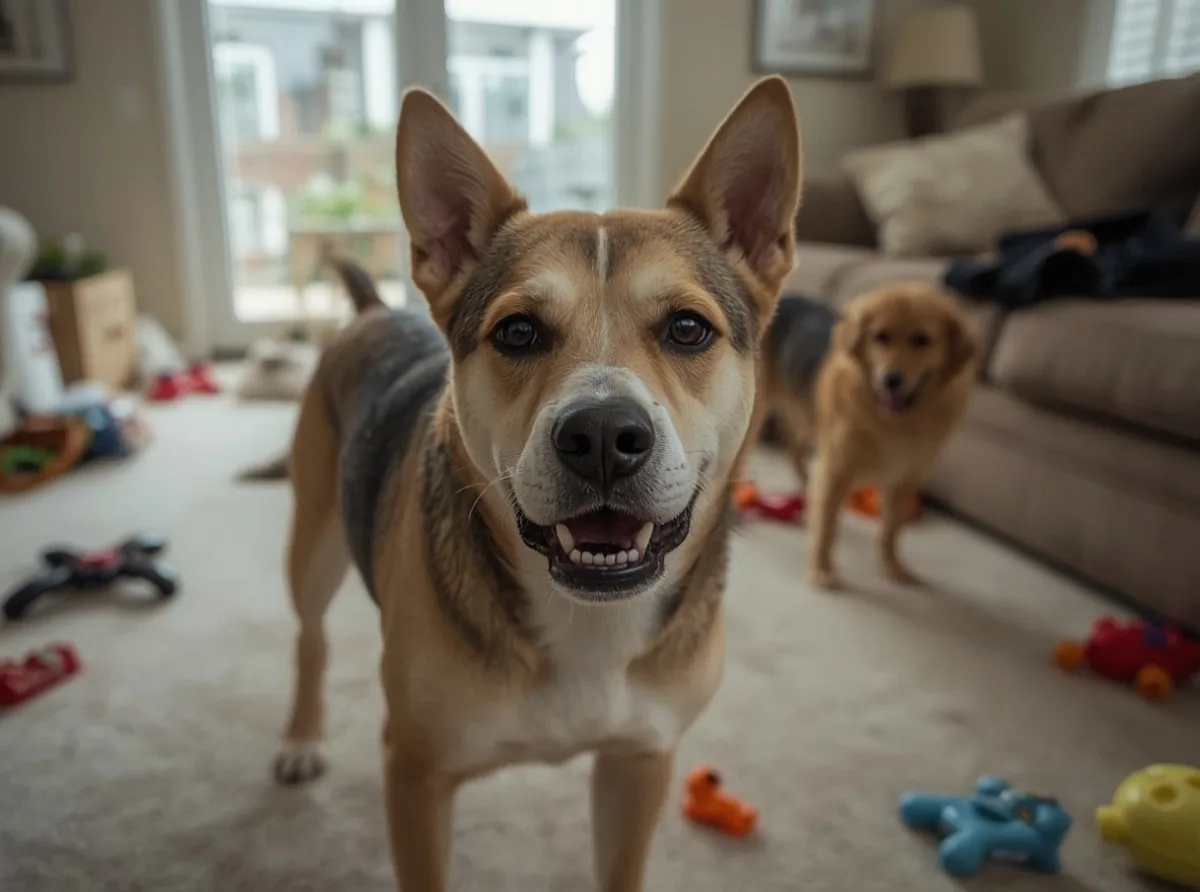
In daily routines, overstimulation often shows up as a dog who cannot quite land. The dog may pace from room to room, grab toys and drop them, bark at small sounds, or keep returning to people as if searching for something but not knowing what. There is movement, but not much settling.
Some dogs get mouthy when overstimulated. They may nip at hands, chew on sleeves, or grab the leash more than usual. Others start spinning, jumping, or racing in circles, especially when the energy in the environment keeps rising.
It can also look quieter than that. A dog may freeze for a moment, stare too hard, or stop responding to familiar cues. Instead of being calm, the dog looks stuck between too much interest and too much tension.
Common everyday signs
- Restless pacing or circling
- Repeated jumping on people
- Hard staring at movement, toys, or other dogs
- Excessive barking at small triggers
- Grabbing, mouthing, or chewing more than usual
- Difficulty lying down or staying in one place
- Inability to take treats or respond to known cues
These behaviors do not always mean the same thing in every dog. A lively puppy may show them during play, while an adult dog may show them after too much noise, excitement, or change. The context is what gives the behavior meaning.
Why dogs become overstimulated
Dogs are constantly taking in information through sound, movement, smell, and social interaction. When too much arrives too quickly, their nervous system can start to lose balance. They are not choosing to be chaotic. They are reacting to overload.
Some dogs are naturally more sensitive than others. A dog that is alert, social, or easily aroused may move from calm to over-the-top faster than a more steady dog. Breed tendencies can play a role, but individual temperament matters just as much.
Experience shapes the response too. A dog that has not learned how to rest in busy environments may reach a tipping point sooner. Another dog may have been rewarded, even unintentionally, for escalating behavior because people only noticed them when they got loud or physical.
Overstimulation is not the same as simple enthusiasm. Excitement still leaves room for control. Overstimulation often starts to erase it.
Internal pressure can build in layers
A dog may begin with curiosity, then move into anticipation, then climb into frustration when they cannot get access to what they want. That can happen at the park, in the car, around guests, near other dogs, or during play. Once the dog is over threshold, small triggers can seem much bigger than they really are.
Some dogs also have trouble shifting out of arousal once it starts. They can remain keyed up long after the original event ends. This is why a dog who seemed fine during the first half of a walk may become snappy or wild near the end.
Situations where overstimulation shows up most often
Overstimulation is common in places where a dog receives a steady stream of input without enough pause. Dog parks, crowded sidewalks, busy households, and holiday gatherings can all create that kind of pressure. Even a home that is not especially noisy can be overstimulating if there are frequent interruptions.
Play sessions are another common setting. Dogs who play well together can still tip into overstimulation if the pace never slows down. Once the excitement turns sharp, play can begin to look rough, frantic, or overly focused.
Walks can also trigger it, especially for dogs that are highly reactive to movement, scents, or other animals. A dog may start the walk in a good mood and end it overwhelmed after too many sights, smells, and sounds.
Places and routines that often contribute
- Dog parks with constant movement
- Homes with frequent visitors or children
- Training sessions with too little rest between repetitions
- Playdates that go on too long
- Busy neighborhood walks with repeated triggers
- Car rides with a lot of visual motion
- Outdoor events, patios, or crowded public spaces
Some dogs are especially sensitive to visual motion. A person moving quickly, a bike passing by, or another dog running in the distance can be enough to push them into a heightened state. Others are more affected by noise or social pressure.
What the behavior may signal about a dog’s emotional state
Overstimulation is often linked to a mix of emotions, not just one. A dog may be excited and uncertain at the same time. They may want to engage but also feel unable to slow down.
In some dogs, the outward energy hides stress. They bark, jump, and scramble because they are uncomfortable, not because they are having a good time. That can be easy to miss when the dog looks busy and animated.
Frustration is another common layer. A dog may be trying to reach a person, another dog, a toy, or a smell and feel blocked. The emotional pressure builds quickly when the desired thing stays just out of reach.
When a dog looks “too excited,” ask whether the dog can still think clearly, recover quickly, and choose a calmer behavior. If not, the issue may be overload rather than enthusiasm.
Subtle signs that often appear before bigger reactions
The earliest signs are often small. A dog may lick their lips repeatedly, yawn outside of sleep time, or scan the room more intensely than usual. Some dogs hold their ears forward and their body rigid, which can look attentive but often means they are on edge.
Others become clingy. They shadow a person from room to room, nudge for attention, or refuse to lie down. The dog is not always asking for more activity; sometimes they are seeking regulation and not finding it.
Heavy panting without exercise, abrupt scratching, or sudden sniffing at the floor can also show up. These behaviors can be a way of discharging tension, or they can signal that the dog is starting to lose emotional balance.
How body language changes when a dog is overstimulated
Body language offers the clearest clues, especially when several signs appear together. A dog may move faster than usual, but the motion is not smooth. It is jerky, repetitive, or hard to interrupt.
The mouth can tell a lot. Some dogs pant with a tight face, while others keep the mouth partly open but with a tense jaw. Saliva, lip tension, and quick snapping toward toys or hands may appear when arousal runs high.
Eye contact changes too. A dog may lock onto movement with intense focus, or glance around rapidly as if tracking too many things at once. Neither pattern suggests calmness.
Body language patterns by intensity
| Level | What it may look like |
|---|---|
| Mild | Restlessness, scanning, brief barking, difficulty relaxing |
| Moderate | Pacing, jumping, mouthing, hard staring, poor response to cues |
| High | Spinning, frantic movement, snapping, sudden shutdown, inability to settle |
A dog can move through these levels quickly if the environment keeps adding stimulation. That is why the difference between “a little excited” and “too much” can be small at first and obvious only after the fact.
How owners often misread overstimulation
Many owners assume the dog needs more exercise, more play, or more attention. Sometimes that is partly true, but often the real issue is not a shortage of activity. It is a lack of recovery.
A dog who seems wild after visitors leave may not need another round of entertainment. The dog may need quiet, distance, and a chance for the nervous system to come down. Piling on more stimulation can make the state worse.
Another common mistake is reading all intense behavior as misbehavior. A dog that grabs, barks, or refuses cues may be overwhelmed rather than defiant. That does not make the behavior harmless, but it does change how it should be understood.
A dog that cannot settle is often telling you the environment is asking for more regulation than the dog currently has available.
How environment, routine, and daily rhythm shape overstimulation
Some dogs do better with a predictable routine because predictability reduces the amount of new input they have to process. When meals, walks, rest, and play happen in a steady pattern, the dog has less reason to stay on alert all day.
But routine alone does not solve everything. A dog can live in a consistent home and still become overstimulated if the day includes too many high-energy moments packed close together. A walk, a training session, a noisy visit, and a game of fetch may be more than the dog can absorb in one stretch.
Household energy matters too. A home with constant television noise, frequent doorbell rings, children running through rooms, and people coming and going can keep a dog in a near-constant state of readiness. Even if nothing looks extreme, the dog may never fully relax.
Daily patterns that can build tension
- Too many active periods with little rest
- Long stretches of unpredictable noise
- Back-to-back social interactions
- Little opportunity to decompress after walks or play
- Rewarding excited behavior without noticing the buildup
- Changing schedules that make the day hard to anticipate
Dogs do not all need the same amount of stimulation, and not every active dog is overstimulated. The difference is often in how the dog handles the input. A balanced dog may enjoy activity and still come back down. An overstimulated dog struggles to do that.
What overstimulation can look like after the trigger is gone
One of the most confusing parts is that the behavior may continue after the exciting event ends. A dog can come home from a walk and still be unable to rest. Another dog may keep barking at sounds or moving around the house long after guests have left.
In some cases, the dog shows what looks like “the zoomies,” but the energy has a sharp, frantic edge. The movement may not be playful in the usual sense. It can feel more like release without control.
Some dogs become needy after overload. They seek contact, then pull away, then return again. They may appear unsettled but not know how to ask for relief in a useful way.
When the pattern is repeating
If the same dog becomes overstimulated in the same settings again and again, the pattern is worth noticing. Repetition can mean the environment is consistently too demanding, or that the dog has learned to stay in a heightened state too long. The behavior may even get stronger over time if the dog rarely gets practice settling earlier.
This is especially common in dogs that live in busy homes and rarely experience true quiet. When a dog never has a chance to wind down, small triggers can accumulate until the reaction looks sudden.
How to tell excitement from overstimulation
Excitement is usually easier to interrupt. The dog may perk up, wag, jump, or bark, but can still respond to a cue, take a treat, or switch into a calmer behavior with some help. The energy is noticeable, but not overwhelming.
Overstimulation is harder to redirect. The dog may ignore known cues, struggle to eat, or seem unable to decide what to do next. There is often more tension in the body and less flexibility in the behavior.
It also helps to watch recovery. A dog who is simply excited often settles after the moment passes. A dog who is overstimulated may stay keyed up, vocal, or restless for much longer.
Useful differences to watch for
- Can the dog still focus briefly?
- Can the dog take food normally?
- Does the dog recover after the event ends?
- Is the body loose or tight?
- Does the dog seem joyful, frustrated, or tense?
- Is the behavior getting bigger instead of calmer?
Why some dogs show overstimulation more than others
Temperament plays a major role. Some dogs are naturally more sensitive to motion, sound, or social intensity. They notice everything, and that can be useful in some settings but exhausting in others.
Age matters as well. Puppies often have bursts of wild energy because their self-regulation is still developing. Adult dogs may show more controlled behavior, but they can still become overloaded if the environment is demanding enough.
Past experiences can lower or raise a dog’s tolerance. A dog that has been rushed through busy environments without breaks may reach a tipping point quickly. Another dog may simply have a smaller buffer and need fewer triggers to feel overwhelmed.
Two dogs can be in the same room and react very differently. The loud one is not always the least comfortable, and the quiet one is not always the most relaxed.
What long-term observation often reveals
Looking at patterns over time can make the picture clearer. If a dog only gets wild during a single game and then settles easily, that may be ordinary arousal. If the dog repeatedly becomes frantic in common situations, overstimulation is more likely part of the story.
It can help to notice when the dog starts to lose balance, not just when things have already gone too far. Some dogs hit their limit after ten minutes of play, while others last much longer but still end up in the same place.
Consistency matters. A dog who regularly shows tension in the same settings is giving useful information. The behavior is pointing to the dog’s threshold, even if that threshold shifts from day to day.
Practical reading of the signs in everyday life
A dog on the edge of overstimulation often gives away the answer before the biggest behavior appears. The movement gets faster. The eyes stay fixed. The body loses softness. Then the barking, grabbing, or frantic running shows up.
What makes this behavior tricky is that it can look different in different dogs. One dog becomes loud and physical. Another becomes clingy and unable to relax. A third gets jumpy, irritable, and oddly unfocused.
Once the pattern is familiar, the clues become easier to spot. The dog is not just having fun, and not simply being stubborn. The dog is taking in more than can be comfortably processed, and the body starts showing it in obvious and subtle ways alike.