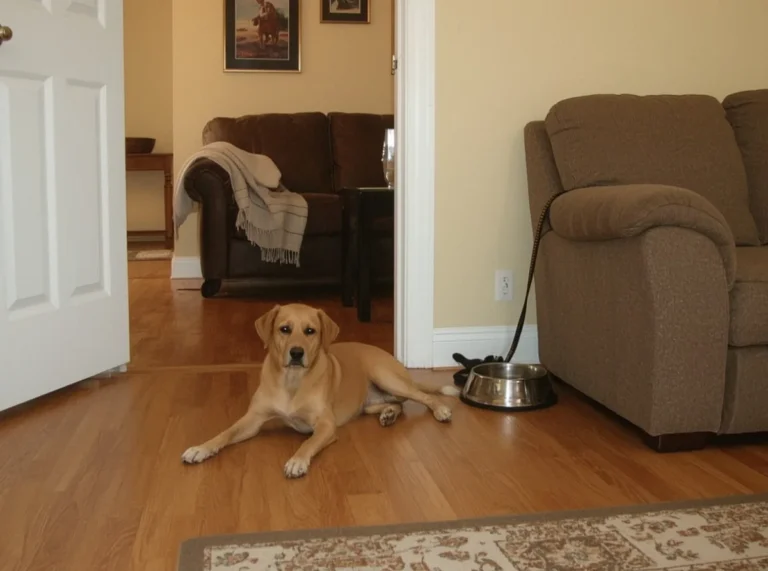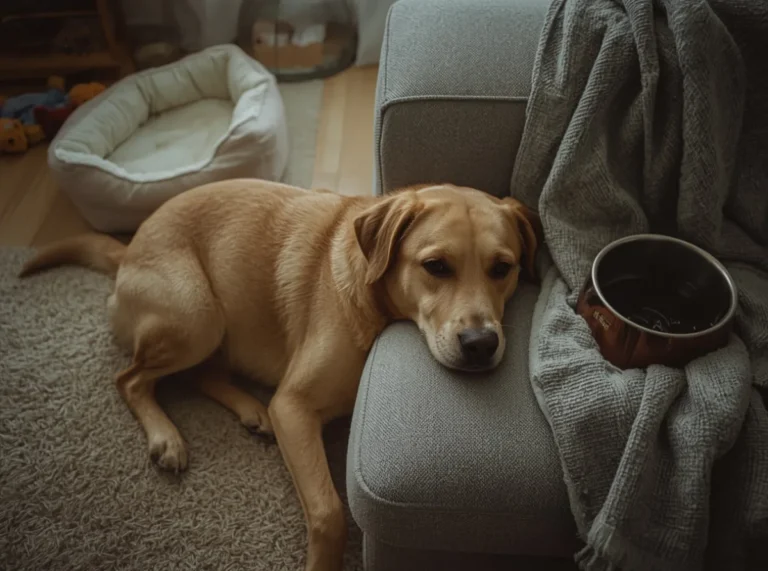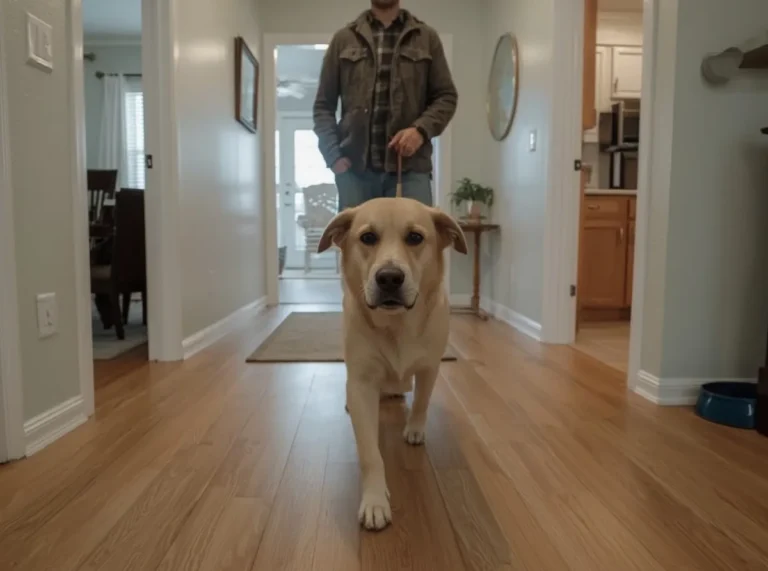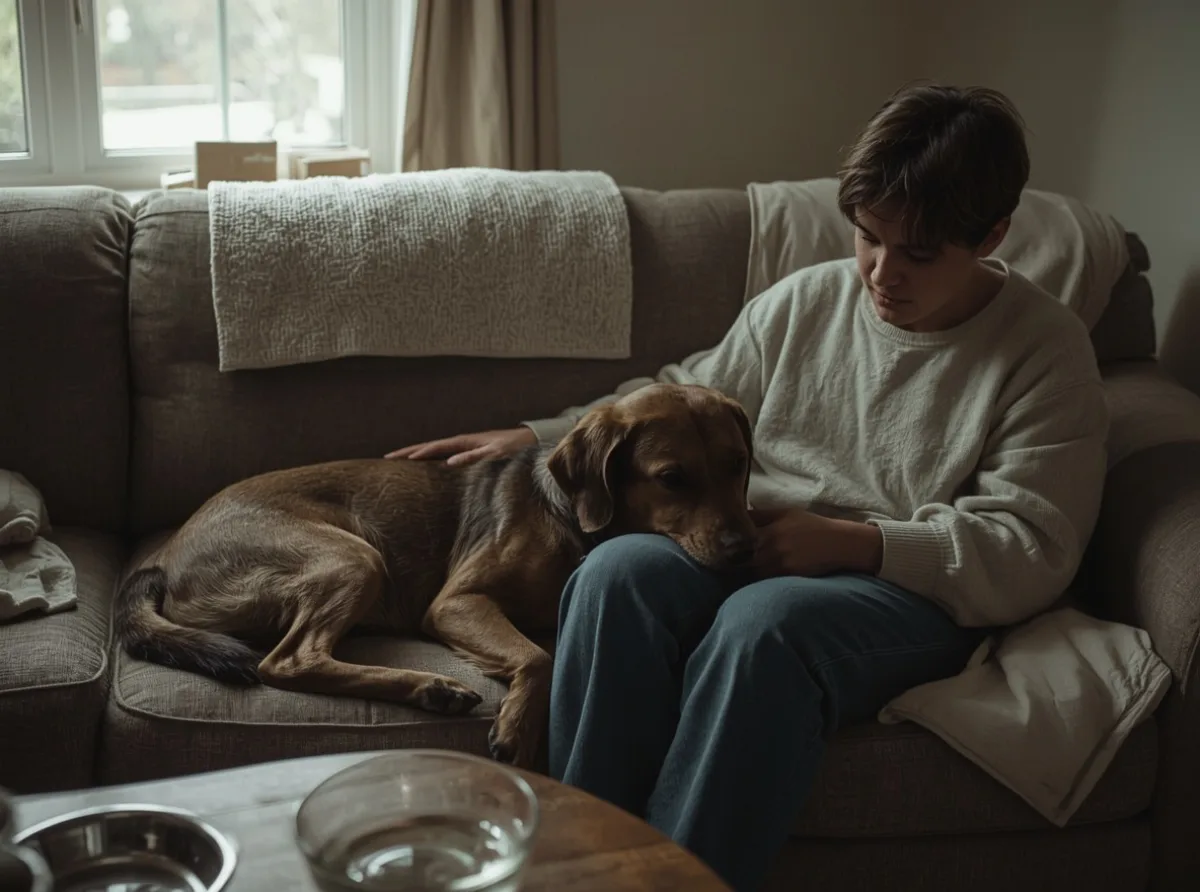
Some dogs seem to notice sadness before a person says a word. They slow down, stop playing, or settle near the nearest chair as if the whole room has changed. The shift can be subtle, but it is often real.
This quiet response is not always about obedience or training. It can come from sensitivity, attachment, routine, and the way dogs read human behavior through movement, voice, scent, and posture. A dog does not need to understand sadness the way people do to respond to it.
In many homes, a dog that becomes quiet around a sad person is not being distant. More often, the dog is adjusting to a change in emotional energy. That adjustment can look like stillness, lowered activity, slower tail movement, or simply choosing to stay nearby without asking for attention.
What this quiet behavior looks like in everyday life
Not every dog reacts the same way, and the signs are often easy to miss if you only expect dramatic changes. Some dogs lie at a person’s feet. Others sit across the room and watch. A few stop seeking games, treats, or their usual burst of affection.
The dog may also move more carefully than usual. A normally bouncy dog might walk instead of trot. A chatty dog may stop barking at noises or stop bringing toys. In a household full of motion, the dog’s calmness can stand out sharply.
Common quiet reactions
- Settling nearby and resting more than usual
- Reducing play or excitement
- Keeping soft eye contact without pushing for interaction
- Following the person from room to room
- Choosing a smaller, calmer space in the home
- Lowering vocalization, including barking or whining
Sometimes the dog does not appear sad at all. The body may look relaxed, but the overall level of activity drops. That difference matters. A calm dog is not always a worried dog, and a quiet dog is not always withdrawn. Context gives the behavior meaning.
Quiet behavior around sadness often means a dog has noticed a change and is responding by reducing activity, not necessarily by becoming fearful or depressed.
Why dogs may react this way emotionally
Dogs are social animals that pay close attention to group members. In a household, people become part of that social world. When one person’s mood shifts, many dogs seem to register it quickly and adapt their own behavior.
One reason is attachment. Dogs often build strong bonds with the people around them, and bonded dogs commonly become more attentive when something seems off. A sad person may move differently, speak less, or carry tension in the face and shoulders. The dog reads those changes and responds with caution or softness.
Another reason is that dogs prefer predictable social cues. Sadness can alter the normal rhythm of a home. Voices become quieter, routines may slow, and less eye contact may happen. A dog that is used to reading a busy, friendly pattern may pause when that pattern changes.
Internal reasons that can influence the response
- Attachment: close bonds make a dog more aware of a person’s state
- Sensitivity: some dogs naturally notice subtle shifts more easily
- Social caution: a dog may reduce excitement when the environment feels different
- Learned association: if sadness has often meant quiet time, the dog may expect less activity
- Emotional mirroring: dogs can match the pace and energy of nearby people
That last point is important, but it should not be overstated. Dogs are not simply copying human sadness. They are often responding to the overall tone of the moment. The reaction is shaped by experience, temperament, and the dog’s understanding of what usually happens next.
How body language and behavior reveal the response
A quiet dog around a sad person may show a cluster of small signals rather than one clear sign. Those signals can be easy to overlook because they are gentle. A dog might blink slowly, sit with a loose body, or hold its ears in a neutral position. The dog may not leave the room, but it may stop asking for attention.
Some dogs become what owners call “shadow dogs” in these moments. They stay close without being demanding. They may rest a chin on a knee, lie near a doorway, or quietly track the person’s movements. That closeness can be comforting, but it can also reflect uncertainty about how to respond.
Other dogs create distance. They go to another part of the house, not because they dislike the person, but because the atmosphere feels different enough to make them pause. In a sensitive dog, that distance can be a form of self-regulation.
Signals that often accompany the quiet response
- Relaxed or lowered head
- Reduced tail wagging speed
- Less bouncing or pacing
- More resting and less spontaneous movement
- Soft facial expression
- Watching the person closely without crowding
These signs mean more when they appear together. A single quiet moment may not tell you much. A pattern across several hours or days tells a clearer story.
Why the home environment matters so much
The same dog may act very differently in two homes, or even on two different days in the same home. Environment shapes how a dog interprets sadness. A peaceful house with regular routines can make a dog more settled and observant. A busy household with constant movement may produce a different reaction, sometimes one that looks almost frozen because the dog has fewer cues to follow.
Routine is especially important. Dogs feel more secure when meals, walks, and play happen at familiar times. When a person is sad, routine often shifts. Walks may get shorter. Conversations may disappear. The dog notices the change, and quiet behavior can increase as a result.
Stimulation also plays a role. A dog with enough exercise and mental engagement may be calmer in general, so the dog’s quiet response is easier to interpret. A dog that is under-stimulated may seem subdued for other reasons, which can blur the picture. In that case, sadness from the person and boredom in the dog may overlap.
A dog’s quietness around sadness is easier to understand when you look at the whole day, not just the emotional moment itself.
Environment factors that can amplify quiet behavior
| Factor | How it can affect the dog |
|---|---|
| Less routine | Creates uncertainty and lowers activity |
| Quiet household | Makes emotional changes more noticeable |
| Busy household | May cause the dog to step back and observe |
| Limited exercise | Can make the dog seem flat or restless in a different way |
| Close attachment to one person | Increases sensitivity to that person’s mood |
When the same quiet response shows up repeatedly in the same setting, it is usually tied to a stable pattern. That pattern may be emotional, environmental, or both.
How dogs may differ in their sensitivity
Some dogs are naturally tuned in to people. They watch faces, follow footsteps, and notice tone changes quickly. These dogs often become quiet around sadness because the emotional shift is obvious to them, even if the sadness is mild.
Other dogs are more independent. They may still notice the change, but they do not adjust as strongly. They continue with normal behavior, maybe with only a slight reduction in play or energy. Neither response is better. They simply reflect different temperaments.
Breed, life experience, and early socialization can all influence sensitivity, but individual personality matters just as much. Two dogs from the same litter may react differently. One may move close to comfort, while the other chooses stillness from across the room.
Ways sensitivity may appear
- Highly sensitive dogs: quick to reduce activity, closely monitor the person, and stay nearby
- Moderately sensitive dogs: noticeable but mild quieting, with some continued interest in play or food
- Low-reactivity dogs: little change in behavior unless the person’s mood affects daily routine strongly
A quiet reaction is not automatically a sign of high intelligence or special emotional insight. It may simply mean the dog is socially aware and prefers to conserve energy when things feel different. The reaction can be practical as much as emotional.
What owners often assume, and what is more likely happening
People sometimes assume a quiet dog is feeling sorry for them in a human way. That interpretation can feel comforting, but it may oversimplify what is going on. Dogs do not need to think in human terms to respond carefully to sadness.
Another common assumption is that the dog is upset or “absorbing” the emotion. In many cases, the dog is not distressed. It is simply less active because the cues around it have changed. The dog may be attentive, but attention is not the same as suffering.
Owners also sometimes mistake quietness for rejection. If a dog does not jump around or bring a toy, it may look uncaring. Usually the opposite is true. A quieter dog may be trying to fit the mood of the room, not avoid the person.
Quiet behavior around sadness is often a social adjustment, not a sign that the dog is emotionally overwhelmed.
Different situations where the behavior appears most clearly
This reaction tends to show up most clearly during familiar routines that suddenly feel different. Evening rest time, after-work quiet, and periods of illness or stress are common examples. The dog notices that a person who is usually active is now slow, still, or absent from normal interaction.
It can also appear when the sad person is someone the dog knows very well. The stronger the relationship, the easier it is for the dog to notice the change. A dog may seem less affected by a guest’s sadness than by the sadness of the person who feeds, walks, and talks to it every day.
Some dogs respond most strongly to subtle sadness rather than obvious crying. They may not react much to tears alone, but they become quiet when the person’s posture, movement, and voice all soften at once. The overall pattern matters more than a single cue.
Situations that commonly bring it out
- Low-energy evenings at home
- Periods of illness or recovery
- Arguments or tense silences
- Changes in walk time or feeding routine
- When a usually active person becomes withdrawn
- Homes where mood changes are frequent and noticeable
Dogs that live in stable homes may react strongly because sadness stands out. In homes with more emotional fluctuation, the dog may become more practiced at reading shifts and responding with calm attention.
When quietness is simply calmness, not a warning
Not every quiet dog is signaling concern. Some dogs are naturally low-key and spend much of the day resting. If a dog is still eating normally, moving comfortably, and engaging when invited, the quiet response may just be part of its usual personality.
It helps to compare the reaction with the dog’s normal baseline. A relaxed dog that always naps near the sofa is not necessarily reacting to sadness in a meaningful way. A lively dog that suddenly stops fetching toys and becomes unusually still is easier to read as responding to the emotional atmosphere.
Timing also matters. If the behavior only appears when a person is upset and then disappears when the mood changes, the connection is likely real. If the dog is quiet across many situations, the cause may be temperament, age, weather, sleep, or health.
Questions worth asking
- Is this dog usually this calm?
- Did the change happen right after the person became sad?
- Is the dog still eating, drinking, and moving normally?
- Does the dog seek proximity or simply sleep in another room?
- Is the behavior different from the dog’s usual routine?
Looking at behavior this way keeps the interpretation grounded. It prevents owners from reading too much into a single quiet moment while still noticing a real emotional pattern when one exists.
How long-term patterns shape the response
Dogs learn from repeated experiences. If sadness in the household has often been followed by quiet evenings, reduced play, and more resting, the dog may begin to expect that pattern. Over time, the dog’s response can become faster and more automatic.
That does not mean the dog is trapped in the pattern. It means the reaction has become familiar. Familiarity often looks like calmness. The dog may settle quickly because it has learned that the room is going to stay still for a while.
Long-term consistency can also reveal when quietness has more to do with the dog’s relationship with one person. Some dogs only change around one family member. Others respond to anyone in the household who seems low or withdrawn. These differences can be helpful clues.
Repeated quiet behavior around sadness usually reflects learning, attachment, and routine together rather than one single cause.
What this reaction says about dog–human interaction
At its core, this behavior shows how closely dogs live with people. They do not just hear words or follow schedules. They watch the emotional shape of a day. When that shape changes, their own behavior often changes too.
The quiet response can be a small but meaningful sign of social awareness. A dog may not understand sadness in a reflective human way, but it can still adjust to a person’s lowered energy, slower pace, and changed habits. That adjustment is part of how dogs share space with people.
In daily life, this may look ordinary. The dog lies down sooner. The room feels a little softer. Fewer games get started. Yet those small changes are often the clearest evidence that the dog has noticed something important.
What matters most is not whether the dog is “feeling the same emotion” as the person. What matters is that the dog is responding to the person’s state in a way that fits its social nature. Quietness can be one form of that response, and in many homes it is the form that appears first.
When the sadness passes and the household rhythm returns, many dogs relax back into their usual behavior without any special event. They play again, ask for attention again, and move through the home with more energy. The change is often simple, but it reveals a lot about how much dogs notice, remember, and adapt.